
Canon EOS Rebel T7 Review: A Beginner-Friendly DSLR with 24.1MP Image Quality
The Canon EOS Rebel T7 is an entry-level DSLR designed for beginner photographers who want interchangeable lenses, dependable image quality, and straightforward controls. Its 24.1-megapixel APS-C sensor, EF-S 18-55mm lens, Full HD video recording, built-in Wi-Fi, and optical viewfinder make it suitable for travel, family photography, portraits, and everyday shooting. The camera is easy to learn and produces detailed images, although its autofocus system, burst speed, and video features are more basic than those found on newer enthusiast cameras.
Introduction
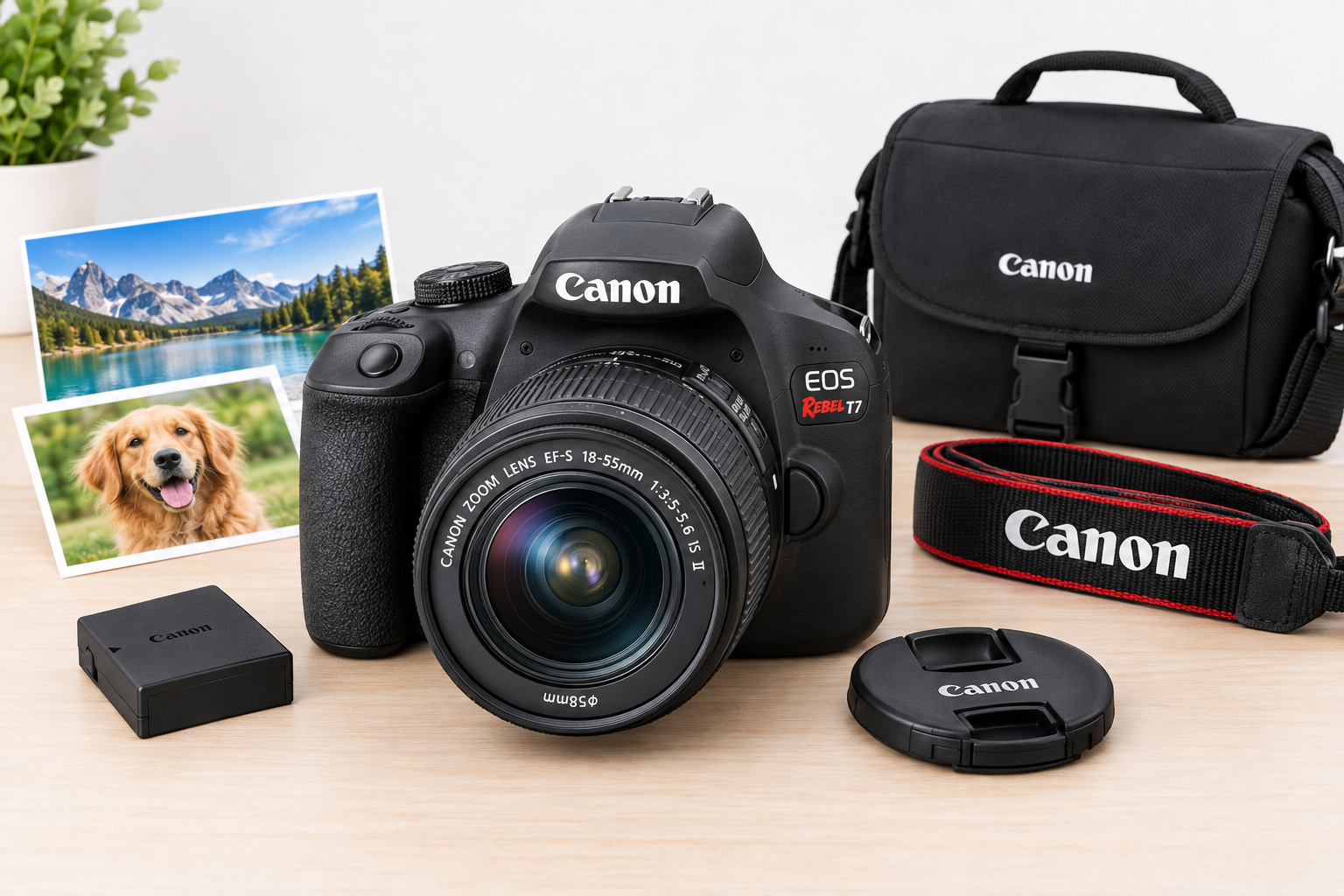
The Canon EOS Rebel T7 DSLR Camera with EF-S 18-55mm Lens is an entry-level interchangeable-lens camera aimed at beginners and casual photographers. It combines a traditional DSLR design with a 24.1-megapixel APS-C CMOS sensor, Full HD video recording, and built-in wireless connectivity.
The Rebel T7 is designed to make the transition from smartphone or compact-camera photography easier while still offering manual controls and access to Canon's broad EF and EF-S lens ecosystem. Its feature set is straightforward rather than cutting-edge, but that simplicity can be an advantage for new photographers learning exposure, composition, and lens selection.
Product Overview and Key Features
24.1-megapixel APS-C sensor
The camera's 24.1-megapixel APS-C CMOS sensor captures detailed photographs with enough resolution for large prints, cropping, and everyday editing. The larger sensor compared with most smartphones and compact cameras also supports more natural background separation when paired with suitable lenses.
The standard ISO range of 100–6400, expandable to ISO 12800, gives the camera flexibility in daylight, indoor environments, and other moderately challenging lighting conditions. Image quality is generally strongest at lower ISO settings, where photographs show the best detail and color consistency.
EF-S 18-55mm kit lens
The included EF-S 18-55mm f/3.5-5.6 IS II lens provides a practical focal-length range for common subjects. Its wide end is useful for landscapes, interiors, and group photos, while the telephoto end works well for portraits and general-purpose shooting.
The lens is compact and relatively light, making it a convenient starting point. However, its variable maximum aperture limits low-light performance and background blur compared with brighter prime or zoom lenses. Photographers who become more experienced may eventually want to add lenses with wider apertures or longer focal lengths.
Beginner-oriented controls
Canon includes automatic shooting modes, scene modes, and creative options that help new users begin taking photographs without immediately learning every manual setting. Manual exposure, aperture-priority, shutter-priority, and program modes are also available for photographers who want more control.
The optical viewfinder provides a direct view through the lens, which can feel responsive and natural during outdoor shooting. A rear LCD screen supports menu navigation and Live View composition, although the camera does not offer the more flexible touchscreen or fully articulating displays found on some newer models.
Full HD video recording
The Rebel T7 records Full HD video at resolutions up to 1920 × 1080. This is suitable for family clips, travel videos, instructional content, and basic online publishing.
Video capabilities are functional but limited by the camera's age and entry-level positioning. Users looking for advanced autofocus during video, 4K recording, high frame rates, or extensive video controls may find the T7 less suitable than a modern mirrorless camera.
Built-in Wi-Fi and NFC
Built-in Wi-Fi and NFC make it possible to connect the camera with compatible mobile devices for image transfer and selected remote-control functions. This is useful for sharing photographs without removing the memory card and for taking self-portraits or group photos from a smartphone.
Wireless performance depends on the connected device, app compatibility, and the shooting environment, but the feature adds convenience that is particularly helpful for travel and social photography.
Performance and User Experience
For still photography, the Canon EOS Rebel T7 delivers the predictable handling associated with Canon's entry-level DSLR lineup. The grip is comfortable, the controls are clearly labeled, and the optical viewfinder can make it easier to follow moving subjects in bright conditions.
The camera uses a 9-point autofocus system and can shoot at up to approximately 3 frames per second. This is adequate for portraits, landscapes, products, travel scenes, and casual family photography. It is less appropriate for fast sports, wildlife, or action photography, where a faster burst rate and more advanced autofocus tracking would be beneficial.
The 18-55mm kit lens provides useful coverage for most beginner assignments. Image stabilization helps reduce the effects of camera shake when shooting handheld, particularly at slower shutter speeds. As with any kit lens, results improve when the photographer pays attention to lighting, focus placement, shutter speed, and composition.
The camera's menus and automatic modes make it accessible to first-time DSLR users, while its manual settings allow room for skill development. This combination gives beginners a clear upgrade path: users can start with automatic modes and gradually learn how aperture, shutter speed, and ISO affect an image.
Pros and Cons
Pros
- 24.1-megapixel APS-C sensor produces detailed still images.
- Straightforward controls are suitable for beginners.
- Includes a versatile 18-55mm kit lens.
- Compatible with Canon EF and EF-S lenses.
- Optical viewfinder provides a traditional DSLR shooting experience.
- Built-in Wi-Fi and NFC simplify image sharing and remote operation.
- Supports Full HD video recording.
- Manual shooting modes provide room to develop photography skills.
Cons
- Autofocus system is basic by current standards.
- Continuous shooting speed is limited for action photography.
- Full HD video lacks newer 4K and advanced autofocus capabilities.
- The kit lens has a relatively slow maximum aperture.
- Rear display lacks touchscreen and vari-angle functionality.
- DSLR body is less compact than many modern mirrorless alternatives.
Conclusion and Recommendation
The Canon EOS Rebel T7 is a sensible starting point for photographers who want an affordable-feeling, easy-to-understand DSLR system with interchangeable lenses. Its 24.1-megapixel sensor delivers strong image resolution for everyday photography, while the 18-55mm lens covers many common shooting situations.
This camera is best suited to beginners, students, families, travelers, and hobbyists who primarily photograph still subjects and want to learn the fundamentals of photography. Built-in Wi-Fi adds practical convenience, and compatibility with Canon's EF and EF-S lenses gives users options for expanding their system over time.
The Rebel T7 is less compelling for photographers who prioritize fast action, advanced video, compact size, or the latest autofocus technology. For those users, a newer mirrorless camera may offer a more modern experience. For straightforward still photography and beginner-friendly learning, however, the Canon EOS Rebel T7 remains a capable and approachable option.