
Hands-On Review: 4K 64MP Dual-Lens Digital Camera for Beginners & Travel Vlogging
This review takes an in-depth look at the **Digital Camera, 4K 64MP Autofocus 16X Zoom Camera with Dual Lens (White)**—a compact point-and-shoot designed for teens, adults, and beginner vloggers. With 4K video, 64MP stills, dual front and rear lenses, 16x digital zoom, anti-shake, and included accessories like a 32GB card and two batteries, it aims to be an easy, all-in-one starter kit for travel, casual photography, and social media content. We examine how simple it is to set up, what daily use looks like, its real-world performance and reliability, key strengths, limitations, and who it ultimately suits best.
Introduction
The Digital Camera, 4K 64MP Autofocus 16X Zoom Camera with Dual Lens (White) is positioned as a compact, easy-to-use point-and-shoot for beginners, teens, and casual creators who want sharper photos and more flexible video than a phone, without the complexity of an interchangeable-lens system.
On paper, it promises 4K video recording, 64MP still photos, dual front/rear lenses for vlogging and selfies, 16x digital zoom, basic anti-shake, and a 3‑inch display. The bundle typically includes a 32GB memory card and two rechargeable batteries, making it a self-contained starter kit.
This review focuses on what that feature set actually means in everyday use: how easy it is to get started, how it behaves in daily shooting, and where it shines or falls short compared with a smartphone or more advanced cameras.
Setup / Getting Started
One of the main selling points of this camera is its beginner-friendly setup.
Unboxing & Included Items
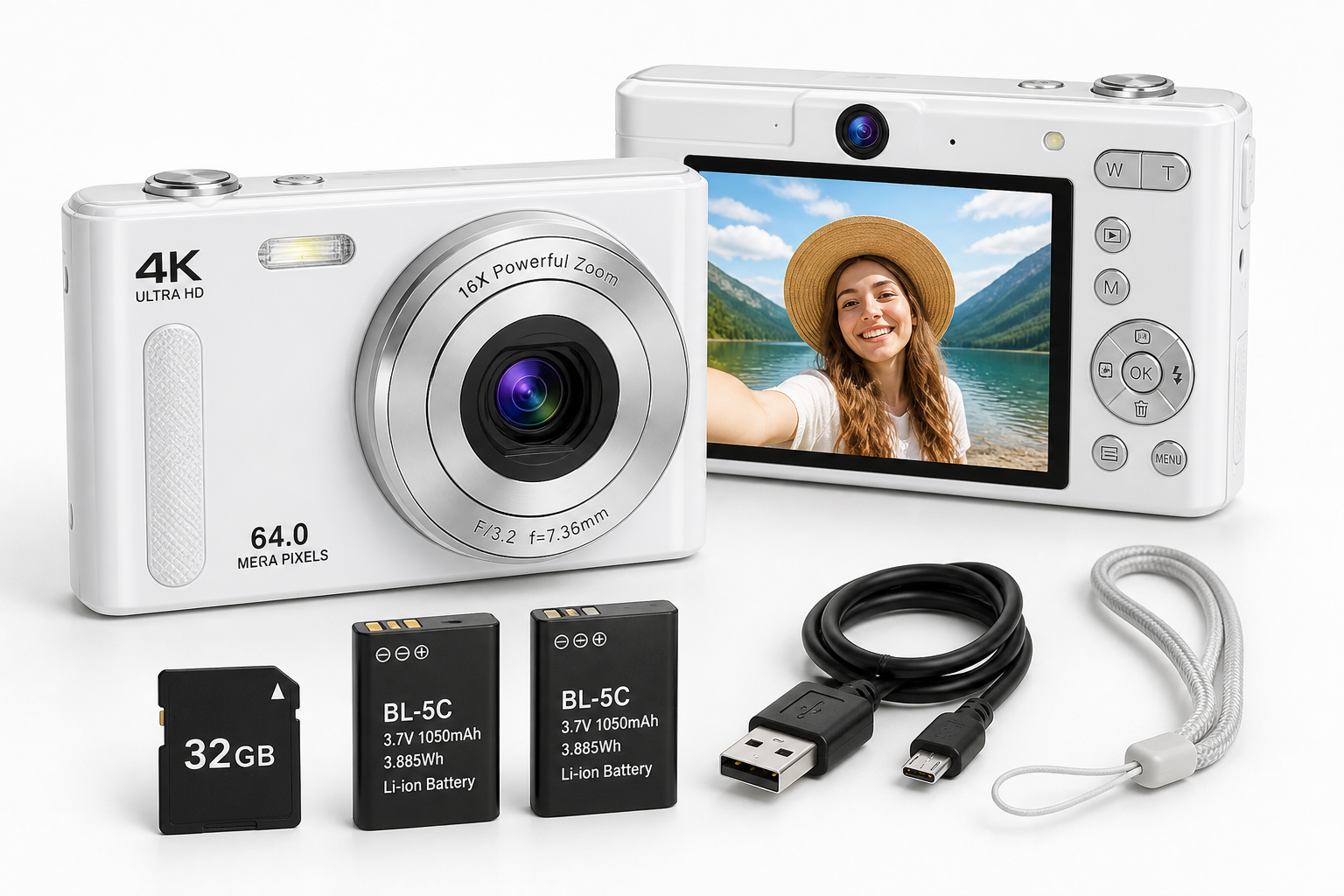
Typical package contents for this model include:
- The camera body (white finish)
- Two rechargeable batteries
- 32GB memory card (usually pre-formatted for use)
- USB charging/data cable
- Wrist strap
- Basic printed manual
Everything you need to begin shooting is in the box, so there’s no need to buy a memory card or extra battery separately right away.
Initial Setup Steps
- Insert the battery and card: Open the battery/memory card compartment, slide in the battery, and insert the 32GB card until it clicks.
- Power on & set language/date: On first boot, you’re typically prompted for language, date, and time—important for organizing photo metadata later.
- Choose resolution settings:
- Set photo size to the maximum (64MP) if you want the most detail.
- Set video resolution to 4K for the sharpest footage, or a lower resolution if you prefer smaller file sizes.
- Familiarize yourself with the mode dial: Most units offer modes such as Photo, Video, Scene/Effect modes, and Playback. Beginners can leave it in the fully automatic photo or video mode.
- Adjust basic preferences: Turn on the grid overlay if available (helps with framing), and ensure anti-shake/image stabilization is enabled.
Overall, the learning curve is gentle. Even users moving up from a smartphone should feel comfortable within a few minutes of exploring the menus.
Daily Usage
In everyday scenarios—travel, family events, school activities, or casual vlogging—the camera aims to provide a straightforward shooting experience.
Handling & Ergonomics
The body is compact and light, easy to carry in a small bag or even a large pocket. The white finish gives it a clean, modern look that many younger users will appreciate. Buttons are generally labeled clearly, with dedicated controls for zoom, shutter, mode switching, and playback.
Because it’s so light, one-handed shooting is easy, but using two hands and the wrist strap is safer and steadier, especially when zoomed in.
Dual-Lens Convenience
A major differentiator is the dual-lens setup—one lens facing forward for regular shooting and another facing toward the user for selfies and vlogging. Switching to the front-facing lens typically only takes a button press or menu selection, allowing you to:
- Record vlog-style videos while seeing yourself on the rear screen
- Take group selfies without awkwardly holding the camera at arm’s length
This makes it appealing for YouTube beginners, TikTok creators, or anyone who wants simple talking-to-camera footage without relying on a smartphone.
Menus & Controls in Practice
Day to day, most people will stay in:
- Photo mode for quick snapshots
- Video mode for casual clips, vlogs, and school or travel projects
The menu systems are basic but serviceable. Beginners may need a little time to understand certain icons and abbreviations, but core tasks—changing resolution, enabling the flash, or formatting the SD card—are straightforward once you’ve done them once or twice.
Battery Life
Battery life is modest but acceptable for a compact camera. The inclusion of two batteries is a practical advantage: you can keep one charging while using the other. For casual shooting, this is often enough to get through a day, provided you avoid constantly recording long 4K clips.
Topping up via USB (often micro USB or USB‑C depending on batch) adds convenience; you can charge from a power bank during travel.
Performance & Reliability
Image Quality (Photos)
The camera advertises 64MP still photos, which is impressive on paper for a compact point-and-shoot. In real-world use:
- Daylight performance: In good lighting, the camera captures colorful, reasonably detailed images suitable for social media, small prints, and everyday memories.
- Autofocus: The autofocus is adequate for static subjects and casual portraits. It’s not as fast or sophisticated as mid‑range mirrorless or higher-end smartphones, but for still scenes and slow movement, it gets the job done.
- 16x Digital Zoom: Zooming is digital rather than optical, meaning image quality softens as you zoom in. Up to a moderate zoom level, results are usable; at the full 16x, expect noticeable loss of fine detail and some noise.
- Low-light performance: In dim indoor or night scenes, image quality drops. Noise and softness become more obvious, and colors can look muted. The built-in flash helps for close subjects but has limited range.
Video Quality
The headline feature is 4K video recording. In suitable lighting:
- Footage appears reasonably sharp and clear, especially at closer distances.
- Colors are generally pleasing for casual content and basic vlogs.
However, there are some practical points to keep in mind:
- Stabilization: The camera offers basic anti-shake, but it’s not on the level of advanced optical or gimbal-like stabilization. Walking shots will still look a bit shaky; holding the camera steady or using a small tripod/mini grip improves results.
- Autofocus in video: It tracks simple subjects competently in decent light, but may hunt or lag if lighting is poor or subjects move unpredictably.
- Audio: Built-in microphones are serviceable for casual use, but they can pick up wind and handling noise. For more serious content creation, an external audio recorder or a separate solution may be preferable, though that adds complexity.
Reliability
For basic use—occasional photos, short video clips, and light vlogging—the camera is generally reliable. Most users will experience:
- Predictable behavior in standard auto modes
- Stable performance as long as the SD card is formatted properly and not filled
- Acceptable thermals for shorter 4K clips
As with many budget 4K devices, very long continuous recordings can increase the risk of overheating or file segmentation, so it’s best to record in shorter takes.
What Works Well
-
Beginner-Friendly All-in-One Kit
With a 32GB card and two batteries included, the camera is ready to use immediately. This makes it especially appealing as a gift for teens or as a first dedicated camera. -
Dual-Lens Design for Vlogging & Selfies
Having both front and rear lenses makes face-to-camera content easier than on traditional point-and-shoots. It reduces guesswork when framing yourself for vlogs or group selfies. -
Compact and Travel-Ready
Lightweight, small, and easy to pack, this camera is a good companion for day trips, vacations, and school activities—situations where carrying a bulky interchangeable-lens camera feels excessive. -
Simple Controls and Auto Modes
Most users can leave the camera in Auto and get reasonably good results in daylight. This reduces the intimidation factor for those not familiar with ISO, shutter speed, or aperture. -
4K and 64MP on Tap
While specs don’t tell the whole story, access to 4K recording and high-resolution stills gives beginners extra headroom for cropping and for viewing on modern displays.
What Could Be Improved
-
Low-Light and Indoor Performance
Like many compact cameras with small sensors and basic lenses, this model struggles in low light. Photos become noisy and soft, and video can look grainy. Relying on the flash helps only at close distances. -
Digital Zoom Limitations
The 16x zoom is purely digital, which inevitably reduces image quality at higher zoom levels. An optical zoom lens would provide sharper results but would also increase size and complexity. -
Stabilization for Handheld Video
The anti-shake function improves minor hand tremors but doesn’t fully smooth walking or running shots. Users who plan to vlog while moving may want a mini tripod, grip, or gimbal for steadier footage. -
Autofocus Speed and Consistency
Autofocus is adequate for casual use but not fast or sophisticated. Action shots, pets, or fast-moving subjects can challenge it, leading to occasional soft frames. -
Audio Quality & Expandability
Built-in microphones are fine for quick clips, but they’re not tuned for professional audio. There’s typically no dedicated external mic input on cameras in this category, limiting upgrade paths for sound.
Overall Impression
The Digital Camera, 4K 64MP Autofocus 16X Zoom Camera with Dual Lens (White) is best understood as a beginner-friendly, all-inclusive starter camera rather than a replacement for higher-end mirrorless or DSLR systems.
It’s a strong fit for:
- Teens and first-time camera owners who want something more dedicated than a phone but not overly complex.
- Casual travelers and families who value a compact, easy-to-share camera for vacations and events.
- New vloggers and social media creators who want front-facing video capabilities without diving into more advanced gear.
It’s less ideal for:
- Users who frequently shoot in poor lighting and expect clean, professional-grade results.
- Those who need fast, reliable autofocus for sports or action.
- Creators requiring advanced stabilization and high-quality audio out of the box.
Within its intended niche—affordable, compact, and approachable—the camera offers a lot of convenience: 4K video, 64MP stills, dual lenses, simple controls, and a useful accessory bundle. For many beginners and casual shooters, that combination will be more than enough to start capturing and sharing better-looking photos and videos with minimal setup and learning curve.