
4K Digital Camera for Photography and Vlogging: Compact 64MP Camera with Flip Screen Reviewed
This review takes an in-depth look at the [4K Digital Camera for Photography, 64MP Vlogging Camera for YouTube with 3" 180° Flip Screen, 18X Digital Zoom Point and Shoot Camera with 32GB Micro SD Card for Beginner (Black)](https://www.amazon.com/dp/B0BQRVCGHC). We examine what this compact camera is, why it matters for beginner photographers and aspiring vloggers, its key advantages and limitations, and the types of users who will benefit the most. The article also clarifies who should skip this model in favor of more advanced gear and concludes with a balanced recommendation based on features, usability, and intended use cases.
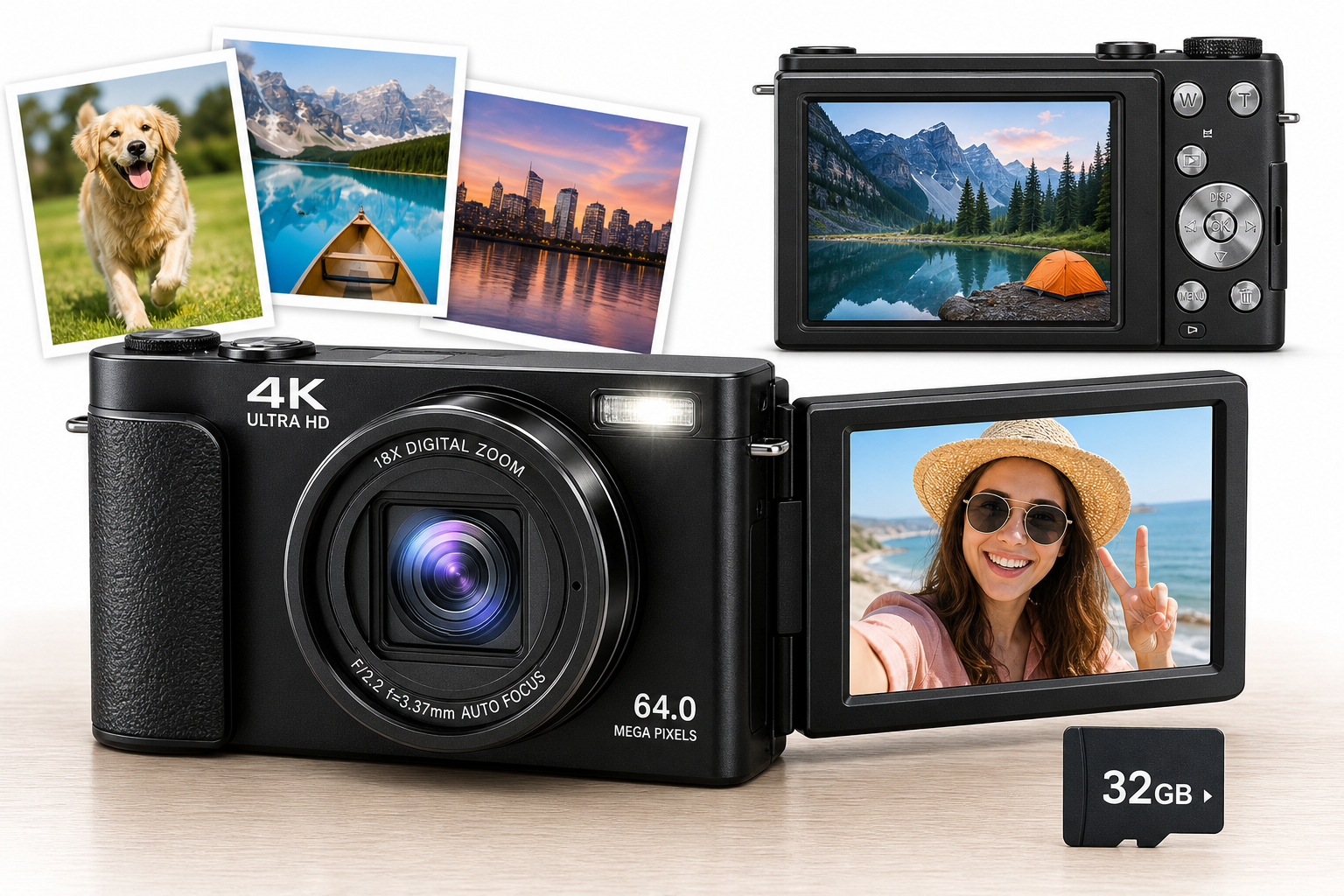
What This Product Is
4K Digital Camera for Photography, 64MP Vlogging Camera for YouTube with 3" 180° Flip Screen, 18X Digital Zoom Point and Shoot Camera with 32GB Micro SD Card for Beginner (Black) is a compact, entry-level digital camera designed primarily for beginners and casual creators who want better photos and videos than a basic smartphone can provide, without dealing with the complexity of interchangeable-lens systems.
In practical terms, this is a lightweight point‑and‑shoot style camera that offers:
- 4K video recording (suitable for YouTube and social media content)
- A high-resolution 64MP still image mode
- A 3-inch rear LCD that flips 180° for front-facing framing
- 18X digital zoom for closer shots without moving your feet
- Included 32GB microSD card to get started out of the box
It’s targeted squarely at:
- Beginner photographers who want a simple, self-contained camera
- Aspiring vloggers who need a front-facing screen
- Travelers and casual users who prefer a dedicated camera to preserve smartphone battery life
Why It Matters
Dedicated cameras like this matter because they occupy an important mid-ground between smartphones and more complex mirrorless or DSLR systems.
- Step up from smartphones: While modern phones are powerful, a dedicated camera can offer more stable framing, a more comfortable grip, and camera-first controls. For users who don’t want to rely entirely on their phone, this camera offers an alternative.
- Creator-friendly design: The 180° flip screen makes it easier for solo creators to frame themselves accurately, something that standard compact cameras without an articulating screen cannot do.
- Low-friction video creation: The combination of 4K recording and simple controls allows new creators to start filming content for platforms like YouTube, TikTok, and Instagram without needing to understand advanced camera jargon.
- Beginner-focused value: By packaging the camera with a memory card and point‑and‑shoot ergonomics, it reduces the barriers to entry for people who have never owned a dedicated camera before.
For users transitioning from phone-only shooting to a real camera, this model can be a confidence-building first step.
Key Advantages
1. 4K Video with 64MP Still Capture
The headline features—4K video and 64MP resolution—are attractive for beginners who want detailed footage and high-resolution images. While absolute image quality depends on sensor size and processing, the ability to record in 4K and capture high-megapixel photos gives users enough headroom for:
- Publishing crisp content on YouTube and other platforms
- Cropping and reframing photos while retaining usable detail
- Printing small to medium-sized photos without visible quality loss
2. 180° Flip Screen for Vlogging
The 3-inch LCD that flips 180° is crucial for vlogging:
- You can see yourself while recording, ensuring proper framing and focus.
- It encourages more natural on-camera presence because you’re confident you’re in the shot.
- It’s also useful for low-angle or overhead shots where a fixed screen would be difficult to view.
This alone makes it notably more creator-friendly than basic compact cameras without flip screens.
3. Beginner-Friendly Point-and-Shoot Design
This camera is clearly built for simplicity:
- Menu systems and controls are generally more straightforward than those on interchangeable-lens cameras.
- Auto and scene modes help new users achieve decent results without deep technical knowledge.
- The compact, lightweight body is easier to carry and less intimidating than larger systems.
The included 32GB microSD card means users can start shooting immediately after unboxing, without needing to purchase storage separately.
4. 18X Digital Zoom for Flexible Framing
While digital zoom doesn’t replace true optical zoom, 18X digital zoom can still be useful in casual scenarios:
- Getting closer views of distant subjects when you physically can’t move closer
- Framing tighter shots for travel, events, or sightseeing
For beginners, having a generously rated zoom option can make the camera feel more versatile than a fixed-lens smartphone.
5. Compact and Travel-Friendly
The form factor appears designed for portability:
- Easy to slip into a small bag or larger pocket
- More comfortable for longer shooting sessions than a heavy camera
- Convenient for travel, day trips, and casual family events
This portability supports the core use case: a simple, go-anywhere camera for photos and videos.
Key Limitations
1. Digital Zoom, Not Optical
The 18X zoom is digital, which means the camera is essentially cropping into the sensor data rather than adjusting lens focal length. The trade-offs:
- Image quality can soften noticeably at higher zoom levels.
- Low-light performance at full digital zoom may be limited.
For critical work or users who demand top-tier sharpness at long focal lengths, a camera with optical zoom or interchangeable lenses would be more suitable.
2. Entry-Level Sensor and Processing
Although the specifications highlight 4K and 64MP, the underlying sensor size and processing are tuned for beginner use, not professional-grade output:
- Low-light performance, dynamic range, and color depth will typically trail behind higher-end mirrorless cameras.
- Fast action, sports, or highly challenging lighting conditions may reveal the camera’s limitations more quickly.
For everyday usage this is acceptable, but advanced users may quickly outgrow it.
3. Limited Advanced Controls and Customization
To keep things beginner-friendly, you should expect a simpler control layout:
- More reliance on auto modes than fine-grained manual control
- Fewer customizable buttons and advanced configuration options
Creators who want extensive manual settings, picture profiles, or log video modes will likely find this camera restrictive.
4. Not Ideal for Demanding Professional Workflows
While it can produce watchable 4K content and high-resolution stills, the overall feature set is aimed at casual or introductory use:
- Workflow features such as advanced audio inputs, robust stabilization, and high-bitrate recording are typically limited at this level.
- Color grading flexibility in post-production will be more constrained than with higher-end 4K cameras.
Professionals or serious enthusiasts who depend on robust codecs and advanced connectivity will likely need a more capable platform.
Who It’s For
This camera is best suited for users who value simplicity, portability, and a low barrier to entry.
You’ll likely be satisfied if:
- You are a beginner photographer who wants to step beyond smartphone photography but doesn’t want the complexity of interchangeable lenses.
- You’re an aspiring vlogger or content creator who mainly publishes to YouTube, TikTok, or Instagram and wants:
- A flip screen for self-framing
- 4K recording for sharp-looking content
- A compact device you can carry every day
- You want a dedicated travel or family camera for vacations, events, and gatherings where pulling out a phone feels limiting or distracting.
- You appreciate an all-in-one starter package, including a memory card so you can begin shooting immediately.
For these users, the 4K Digital Camera for Photography, 64MP Vlogging Camera for YouTube with 3" 180° Flip Screen, 18X Digital Zoom Point and Shoot Camera with 32GB Micro SD Card for Beginner (Black) provides a straightforward path into dedicated camera ownership.
Who Should Skip It
You may want to skip this model and look for alternatives if:
- You need professional-grade image and video quality. If you’re shooting commercial projects, weddings, or client work, you’ll likely need:
- Larger sensors
- Higher-end lenses
- More robust codecs and connectivity
- You prioritize low-light performance or fast action. Sports, concerts, and night scenes demand stronger sensors, optics, and autofocus systems than an entry-level compact can usually provide.
- You require advanced manual control and customization. If you are already familiar with aperture, shutter speed, and ISO and want:
- Dedicated manual controls
- Custom profiles
- Extensive configuration, then a mid-range mirrorless or DSLR will be more fulfilling.
- You are deeply invested in smartphone photography and satisfied with it. High-end phones now offer excellent cameras with strong computational photography. If you already own such a device and are comfortable editing on your phone, a separate camera may add complexity without a major benefit for you.
Final Recommendation
The 4K Digital Camera for Photography, 64MP Vlogging Camera for YouTube with 3" 180° Flip Screen, 18X Digital Zoom Point and Shoot Camera with 32GB Micro SD Card for Beginner (Black) fills a clear niche: it’s a beginner-focused, compact 4K camera that makes it easy for new photographers and aspiring vloggers to get started.
Its strengths lie in:
- 4K video and 64MP stills for detailed everyday content
- A 180° flip screen that’s well-suited to solo creators
- Simple, point‑and‑shoot operation with an included memory card
- A compact, travel-friendly design
Its compromises—digital rather than optical zoom, entry-level sensor and processing, and a focus on simplicity over advanced control—are consistent with its role as a starter camera rather than a professional tool.
If you’re a beginner or casual creator looking for an affordable, straightforward way to record 4K videos and capture high-resolution photos without battling complex camera systems, this model is a reasonable and practical option to consider. Users who anticipate rapid progression into more demanding creative work, however, may be better served by viewing it as a stepping stone and planning an eventual upgrade to a more advanced camera system.