
Canon EOS R50 Mirrorless Camera Kit with 18–45mm Lens: Compact Hybrid Camera for Content Creators
This review takes an in-depth look at the Canon EOS R50 Mirrorless Camera Kit – an APS-C RF-mount camera paired with the RF-S 18–45mm lens, plus a shoulder bag and 64GB memory card. We examine its 4K video capabilities, Dual Pixel CMOS AF II autofocus system, vari-angle touchscreen, compact design, and connectivity options. You’ll learn where the R50 excels (travel, vlogging, beginner hybrid shooting), where it falls short (limited lens range in the kit, smaller body for heavy lenses, no in-body image stabilization), and whether this all-in-one package is the right entry point into Canon’s RF ecosystem for your specific needs.
What This Product Is
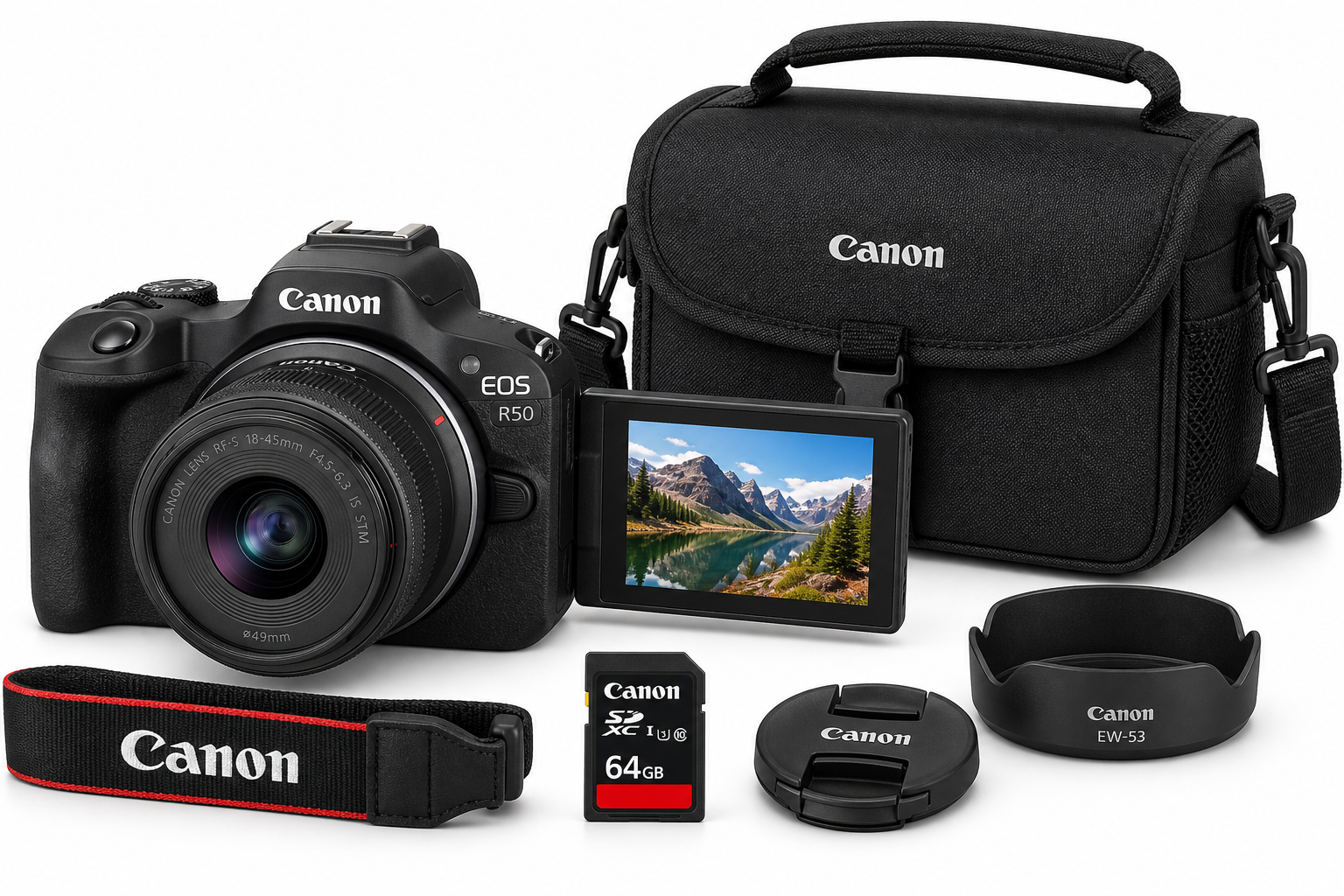
The Canon EOS R50 Mirrorless Camera Kit is a compact APS-C mirrorless camera package built around Canon’s RF mount. The kit typically includes:
- Canon EOS R50 mirrorless camera body (APS-C sensor)
- Canon RF-S 18–45mm F4.5–6.3 IS STM kit lens
- Canon-branded shoulder bag
- 64GB SD memory card
Positioned above basic point‑and‑shoots and smartphone cameras, the R50 is aimed at creators who want interchangeable lenses, better low‑light performance, and reliable 4K video in a small, travel‑friendly body. It combines Canon’s Dual Pixel CMOS AF II autofocus, uncropped 4K video oversampled from a 6K readout, and a fully articulating touchscreen to create an approachable hybrid camera for both stills and video.
Why It Matters
As more photographers and creators move to mirrorless systems, many are looking for a single purchase that gets them shooting immediately. This kit matters because it solves several early hurdles at once:
- You get a modern RF-mount body that can grow with you as you add lenses.
- The included 18–45mm zoom covers everyday focal lengths for travel, family events, and basic vlogging.
- A 64GB card and shoulder bag remove two common barriers: storage and safe transport.
For beginners, students, and solo creators, the R50 aims to be a straightforward step up from smartphones: better image quality, better control, and more versatility without a steep learning curve or a bulky camera bag.
Key Advantages
1. APS-C Sensor with RF Mount
The Canon EOS R50 uses a 24.2MP APS‑C CMOS sensor combined with Canon’s RF mount. This brings several practical benefits:
- Better image quality than most phones: larger sensor, cleaner images, and improved background separation.
- Access to RF and RF-S lenses: you can use compact APS-C RF-S lenses or step up to full-frame RF lenses as your needs grow.
- Good balance of size and performance: APS‑C keeps the camera and lenses relatively small while still offering strong image quality.
2. 4K Video with Dual Pixel CMOS AF II
For content creators and vloggers, the video feature set is a major selling point:
- 4K video oversampled from 6K (on applicable modes), which typically yields sharper, more detailed footage than line‑skipped 4K.
- Dual Pixel CMOS AF II delivers fast, confident autofocus with subject detection for people, and it is designed to track faces and eyes effectively in both stills and video.
- Reliable continuous AF for vlogging so you can move toward or away from the camera without constant manual refocusing.
These capabilities make the R50 a strong option for YouTube, TikTok, streaming, and educational content where consistent focus and sharp video are important.
3. Vari‑Angle Touchscreen for Flexible Shooting
The R50 features a fully articulating (vari‑angle) LCD touchscreen, which is especially useful for creators:
- Flip the screen to face forward for self‑recording, vlogging, and talking‑head content.
- Tilt it up or down for low‑angle or overhead shots without guessing your framing.
- Touch controls make menu navigation and AF point selection straightforward, even for users coming from smartphones.
4. Compact, Lightweight Design
One of the main strengths of this kit is its portability:
- The R50 body and 18–45mm lens form a lightweight combination you can carry all day.
- The included shoulder bag is sized to hold the camera, kit lens, and basic accessories.
- Its small footprint makes it less intimidating for first‑time mirrorless users and easy to pack for travel.
5. Creator-Friendly Features and Connectivity
The EOS R50 includes several quality‑of‑life features tailored to modern creators:
- Guided user interface and creative assist tools to help beginners understand exposure, background blur, and color.
- Vertical video support and on‑screen cues to make it easier to shoot content formatted for social platforms.
- Built‑in Wi‑Fi and Bluetooth for quick transfer to your phone, remote control, and straightforward sharing.
Together, these features help bridge the gap between smartphone convenience and dedicated-camera quality.
Key Limitations
No camera is perfect, and the Canon EOS R50 kit has some trade‑offs that are important to understand before you buy.
1. Modest Kit Lens Range and Aperture
The RF‑S 18–45mm F4.5–6.3 IS STM lens covers a useful but limited zoom range:
- The 18–45mm focal length (approximately 29–72mm full‑frame equivalent) works well for general use, but it doesn’t reach very wide for tight indoor spaces or very long for distant subjects.
- The variable, relatively slow maximum aperture (F4.5–6.3) means it’s not the brightest lens. In low light you may need higher ISO settings or support from the built‑in optical image stabilization and lens IS.
Many users will eventually want to add a faster prime lens (for subject separation and low light) or a longer zoom for wildlife, sports, or events.
2. No In‑Body Image Stabilization (IBIS)
The R50 relies on lens‑based optical image stabilization (OIS) and digital stabilization rather than having IBIS in the camera body:
- With the 18–45mm IS lens, you still get effective stabilization for handheld stills and basic video.
- However, lenses without stabilization won’t benefit from sensor‑shift IBIS, which can be noticeable when using non‑IS primes or adapted glass.
For creators who frequently shoot handheld video, especially while walking, this is a trade‑off you should consider.
3. Smaller Body, Limited Headroom for Heavy Lenses
The compact body design is a plus for portability but can be a limitation:
- Grip size may feel small for users with large hands or when using bigger RF lenses.
- Heavier lenses can make the setup front‑heavy and less balanced, reducing comfort during long sessions.
If you plan to invest in large telephoto or fast zoom lenses, a more robust RF body might be a better match down the line.
4. Geared More Toward Beginners and Enthusiasts
While the R50 offers strong performance, it is not positioned as a professional workhorse:
- Advanced shooters may miss certain pro‑level controls, deeper buffer capacity, or weather sealing you’d find on higher‑end bodies.
- The feature set leans toward ease of use and automation, which is ideal for many users but less tailored to those who want extensive manual customization.
Who It’s For
The Canon EOS R50 Mirrorless Camera Kit – APS‑C RF Camera with 18–45mm Lens, 4K Video, Dual Pixel AF II & Vari‑Angle Touchscreen (5811C012) + Shoulder Bag + 64GB Memory Card is best suited to:
- Beginner and intermediate photographers ready to move beyond smartphones or compact cameras into an interchangeable‑lens system.
- Vloggers and solo creators who need reliable autofocus, 4K video, a flip‑out screen, and a simple all‑in‑one package.
- Travelers and everyday shooters who value a small, light camera they can carry without hassle.
- Students and hobbyists exploring photography and video who want room to grow within the Canon RF ecosystem.
If you want a straightforward, low‑friction path into mirrorless and content creation, this kit is designed to get you started on day one.
Who Should Skip It
You may want to look elsewhere if:
- You need pro‑level durability or advanced controls for heavy commercial or event work.
- You rely on strong in‑body stabilization for handheld video with non‑IS lenses or for shooting in very low light without support.
- You primarily shoot fast action or demanding sports, where a more advanced autofocus system, deeper buffer, or higher‑end body might be beneficial.
- You already own substantial Canon EF or EF‑S glass and prefer a body where an EF‑to‑RF adapter is part of a broader, long‑term system plan—though the R50 can still serve as a compact secondary body in that case.
Final Recommendation
The Canon EOS R50 Mirrorless Camera Kit delivers an appealing balance of image quality, video capability, autofocus performance, and portability in a ready‑to‑shoot package. The inclusion of the RF‑S 18–45mm lens, shoulder bag, and 64GB card makes it a practical starter kit for beginners and content creators who want to upgrade from a phone without assembling a system piece by piece.
Its strengths—sharp oversampled 4K video, Dual Pixel CMOS AF II, vari‑angle touchscreen, and compact design—make it particularly attractive for vlogging, travel, and everyday hybrid shooting. The main compromises are the modest kit‑lens range and aperture, the absence of in‑body image stabilization, and a body design that’s optimized more for portability than for large, heavy lenses.
If your priority is a small, capable, and easy‑to‑use mirrorless camera that can handle both photos and 4K video with minimal setup, the Canon EOS R50 kit is a strong option and a sensible entry point into Canon’s RF ecosystem.