
Canon EOS Rebel T7 Double Zoom Lens Kit Review: A Beginner-Friendly DSLR with Room to Grow
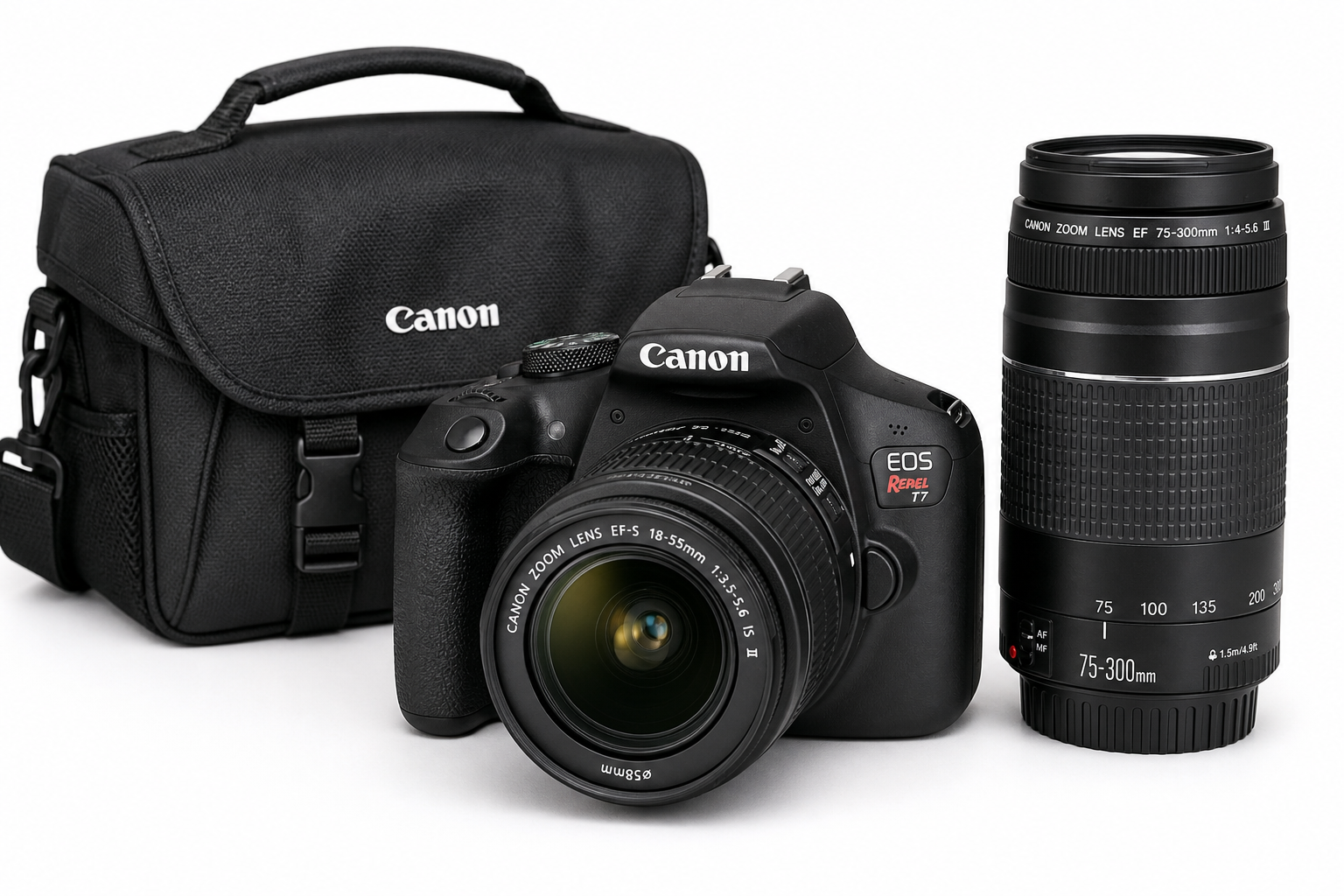
This review examines the **Canon EOS Rebel T7 DSLR Camera Double Zoom Lens Kit with EF-S 18-55mm and EF 75-300mm lenses**, focusing on its 24.1MP APS-C sensor, beginner-friendly ergonomics, Full HD video, built-in Wi‑Fi and overall suitability for new photographers. We look at how the dual-lens kit performs for everyday photography, portraits, travel, sports and wildlife, highlighting strengths like image quality, familiar DSLR handling and lens versatility, alongside limitations such as basic autofocus, lack of 4K video and the non-stabilized EF 75-300mm lens. The goal is to help beginners decide whether this long-standing DSLR kit is still a good starting point in a mirrorless-focused market.
Introduction
The Canon EOS Rebel T7 DSLR Camera Double Zoom Lens Kit combines Canon’s entry-level DSLR body with two lenses: the EF-S 18–55mm f/3.5–5.6 IS II standard zoom and the EF 75–300mm f/4–5.6 telephoto zoom. Centered around a 24.1‑megapixel APS‑C CMOS sensor and Canon’s DIGIC 4+ image processor, this kit targets beginners who want a straightforward, optical-viewfinder shooting experience with enough focal-range coverage to explore everything from landscapes and portraits to distant subjects.
With Full HD (1080p) video recording, built-in Wi‑Fi and NFC for easy sharing, and familiar DSLR controls, the Rebel T7 aims to be a first serious camera that can also grow with you as you learn. This review focuses on how the kit behaves in real-world usage, its strengths and trade-offs, and which types of photographers will benefit most.
Typical Use Cases
-
Everyday and Family Photography
- Capturing kids, pets and day‑to‑day moments at home or in the park.
- Using the 18–55mm lens for casual snapshots and quick portraits.
-
Travel and Street Photography
- Lightweight walkaround shooting with the 18–55mm for cityscapes and landmarks.
- Occasional use of the 75–300mm to compress distant scenes or architectural details.
-
Portraits and Social Media Content
- Head‑and‑shoulder portraits with background blur at the longer end of the 18–55mm range.
- Content creation for Instagram or similar platforms, benefiting from Wi‑Fi image transfer.
-
Sports, Wildlife, and Outdoor Events
- Using the 75–300mm to photograph kids’ sports, wildlife at the zoo, or distant performers on a stage.
- Shooting mainly in good light, such as daytime games or outdoor events.
-
Beginner Photography Learning Tool
- Practicing exposure, composition and focusing using a traditional DSLR interface.
- Exploring different focal lengths to understand perspective and compression.
- Expanding later with additional Canon EF or EF‑S lenses.
-
Basic Video Recording
- Recording 1080p clips for home videos, school projects or simple online content.
- Occasional vlogging or talking‑head videos with tripod support.
Performance in Each Scenario
Everyday and Family Photography
With its 24.1MP APS‑C sensor, the Rebel T7 delivers detailed, clean images at low to moderate ISO settings. For everyday shooting around the house or outside, image quality is more than sufficient for prints and online sharing. Colors are characteristically Canon—pleasing and slightly warm—straight out of camera.
The included EF‑S 18–55mm f/3.5–5.6 IS II lens is well suited for this role. Its 18–55mm focal range (roughly 29–88mm equivalent on APS‑C) covers wide to short‑telephoto perspectives, ideal for group shots at 18mm and tighter portraits at 50–55mm. Optical image stabilization helps keep images sharp in lower light at slower shutter speeds, which is especially useful indoors.
Autofocus performance is basic but adequate for still or moderately moving subjects. The 9‑point AF system with a central cross‑type point is reliable in good light, though it can hunt or slow down in dim conditions. For candid family moments, it works well when paired with some anticipation and good technique.
Travel and Street Photography
For travel, the T7 offers a balance between image quality and portability. It is lighter and more compact than many higher-end DSLRs, yet still provides a substantial grip and optical viewfinder that some photographers prefer over a smartphone or compact camera.
The 18–55mm lens again carries most of the load here. At 18mm, it can capture wide scenes, while mid‑range focal lengths handle everyday city and street shots. The camera’s JPEG engine does a good job at handling contrasty situations and preserving detail, though serious users may prefer to shoot RAW for maximum flexibility.
Battery life is typically better than most smartphones and many mirrorless bodies, making it suitable for long days of sightseeing. Built‑in Wi‑Fi and NFC allow you to send selected shots to a phone or tablet for quick social sharing without needing a computer.
Portraits and Social Media Content
Portraits are an area where the Rebel T7 can shine despite its entry‑level status. The APS‑C sensor allows for reasonably shallow depth of field, especially when you zoom the 18–55mm lens to the longer end and position your subject away from the background.
Skin tones tend to look natural, and Canon’s Picture Styles can be tweaked to taste. Even without a dedicated portrait lens, the kit can deliver flattering results for headshots, family portraits, and social media images. Adding a fast prime lens in the future, such as a 50mm f/1.8, would further enhance portrait capability without replacing the body.
Wi‑Fi connectivity makes it simple to push JPEGs to your phone, run them through your favorite editing apps, and publish them quickly. The camera’s resolution is more than enough for all mainstream social platforms.
Sports, Wildlife, and Outdoor Events
The EF 75–300mm f/4–5.6 telephoto zoom is the defining feature of this double zoom kit for many buyers. On the APS‑C sensor, it gives a field of view equivalent to roughly 120–480mm, letting you frame distant subjects from the sidelines or stands.
In bright daylight, the lens can produce respectable results. The longer reach allows you to isolate players, animals, or performers, and the T7’s sensor retains good detail when exposure is handled carefully. However, several limitations are important to understand:
- The 75–300mm lens does not include image stabilization, making camera shake a concern at longer focal lengths. Using faster shutter speeds and good hand‑holding technique, or a monopod/tripod, is recommended.
- The maximum aperture (f/4–5.6) limits low‑light performance. To avoid motion blur in evening games or overcast conditions, you may need to raise ISO, which introduces more visible noise.
- The camera’s continuous shooting speed and AF tracking are modest, making it less capable for fast, professional‑level sports coverage.
For casual sports and wildlife in good light, the kit can certainly deliver usable images and help beginners learn telephoto technique. Photographers who expect to shoot action regularly, especially in poor light, may eventually want to upgrade lenses or bodies.
Beginner Photography Learning Tool
As a learning camera, the Rebel T7 has several advantages:
- Traditional DSLR layout: Dedicated buttons, physical mode dial, and an optical viewfinder make exposure and focus behavior easier to visualize as you move out of Auto mode.
- Full manual controls: Aperture Priority (Av), Shutter Priority (Tv), and full Manual exposure modes are all present, enabling proper learning of exposure fundamentals.
- Compatible lens ecosystem: The EF/EF‑S mount gives access to a wide range of Canon and third‑party lenses, from budget primes to more specialized zooms.
The supplied lenses cover a broad focal range, allowing students to understand how wide, standard, and telephoto perspectives differ. Combined with the camera’s straightforward menus and familiar Canon ergonomics, it can be an effective tool for teaching or self‑study.
Basic Video Recording
The Rebel T7 records Full HD (1080p) video, which is sufficient for most casual uses. It is suitable for:
- Home videos and school projects.
- Static talking‑head content on a tripod.
- Simple clips of events or travel scenes.
However, the video feature set is basic by modern standards. There is no 4K option, the autofocus during video is slower and less smooth than newer hybrid‑AF or mirrorless systems, and the camera lacks advanced video‑oriented tools. For creators primarily focused on video or vlogging, a more video‑centric camera may be a better choice.
Strengths Across Scenarios
-
Good Image Quality for an Entry-Level DSLR
The 24.1MP APS‑C sensor offers detailed images with good dynamic range for the class. At low ISO, files are clean and flexible enough for editing, suitable for prints and online use. -
Beginner-Friendly Handling and Interface
The Rebel series is known for intuitive controls and menu design. The T7 follows this tradition, making it easy for new users to move from fully automatic modes into semi‑manual and manual control at their own pace. -
Versatile Two-Lens Coverage
The combination of 18–55mm and 75–300mm provides a wide focal‑length span. Beginners can experiment with landscapes, portraits, and distant subjects without needing to buy additional lenses immediately. -
Optical Viewfinder Experience
For many photographers, an optical viewfinder is more natural than composing on a screen. It’s bright, lag-free, and works well in bright sunlight, offering a classic DSLR shooting experience. -
Wi‑Fi and NFC Connectivity
Built‑in wireless features simplify transferring images to mobile devices, which is particularly valuable for social media‑focused users and travelers who want to share quickly. -
Access to Canon EF/EF‑S Lens Ecosystem
Even though this is an entry-level body, it can use a broad array of Canon EF and EF‑S lenses, allowing significant system growth without replacing the camera immediately.
Limitations Across Scenarios
-
Older Autofocus and Burst Performance
The 9‑point AF system and modest continuous shooting speed are serviceable but dated relative to newer DSLRs and mirrorless cameras. Tracking fast action or erratically moving subjects can be challenging. -
Limited Low-Light and Action Capability
With relatively slow kit lenses (especially the telephoto zoom) and no in‑body stabilization, performance in dim light is constrained. You may need higher ISO settings, which introduce more noise, and faster shutter speeds for action may not always be achievable. -
Non-Stabilized Telephoto Lens
The included 75–300mm lens lacks optical image stabilization, making long‑end shooting more demanding. Blur from camera shake is a frequent issue if shutter speeds are too low, particularly for beginners. -
Basic Video Feature Set
No 4K support and limited continuous AF responsiveness during video make the T7 less suitable for serious videography. Content creators who prioritize video may find these constraints restrictive. -
Aging Platform in a Mirrorless-Focused Market
While still capable, the Rebel T7 belongs to an older generation of DSLR technology. Newer mirrorless options often provide faster autofocus, better live‑view performance, higher‑resolution screens, and more advanced video modes. -
No Articulating Screen or Advanced Ergonomic Features
The fixed LCD and lack of features like in‑body stabilization or advanced customizable controls may limit flexibility for some shooting styles, especially low or high‑angle compositions and solo video work.
Verdict
The Canon EOS Rebel T7 DSLR Camera Double Zoom Lens Kit with EF-S 18–55mm and EF 75–300mm Lenses is a practical, beginner‑oriented package that offers solid still‑image quality, familiar DSLR ergonomics, and a wide focal‑length range right out of the box. It is particularly well suited to:
- New photographers who want to learn manual exposure and lens behavior.
- Families and hobbyists prioritizing still photos over advanced video.
- Users who value an optical viewfinder and straightforward handling.
At the same time, its aging autofocus system, basic video capabilities, and non‑stabilized telephoto lens highlight that this is not a cutting‑edge camera. Photographers who expect to shoot a lot of action, work regularly in low light, or focus heavily on video may quickly encounter the platform’s limits and look toward more modern alternatives.
For beginners who value an affordable path into interchangeable‑lens photography and appreciate the feel of a traditional DSLR, the Canon EOS Rebel T7 double zoom kit remains a competent and educational starting point. With thoughtful technique and a clear understanding of its strengths and limitations, it can serve as a reliable first step into serious photography.