
KODAK PIXPRO C1 Review: A Retro-Style Compact for Casual Selfies and Everyday Snapshots
This review looks at the KODAK PIXPRO C1 13MP compact digital camera, a retro-styled point‑and‑shoot with a 26mm F2.0 fixed lens, 2.8‑inch 180° flip screen, 1080p Full HD video, and built‑in Li‑ion battery. We examine its image quality, ease of use, selfie and vlogging capabilities, strengths and compromises of the fixed‑focus design, and overall value for casual users who want a dedicated camera with a nostalgic digicam aesthetic.
Quick Summary
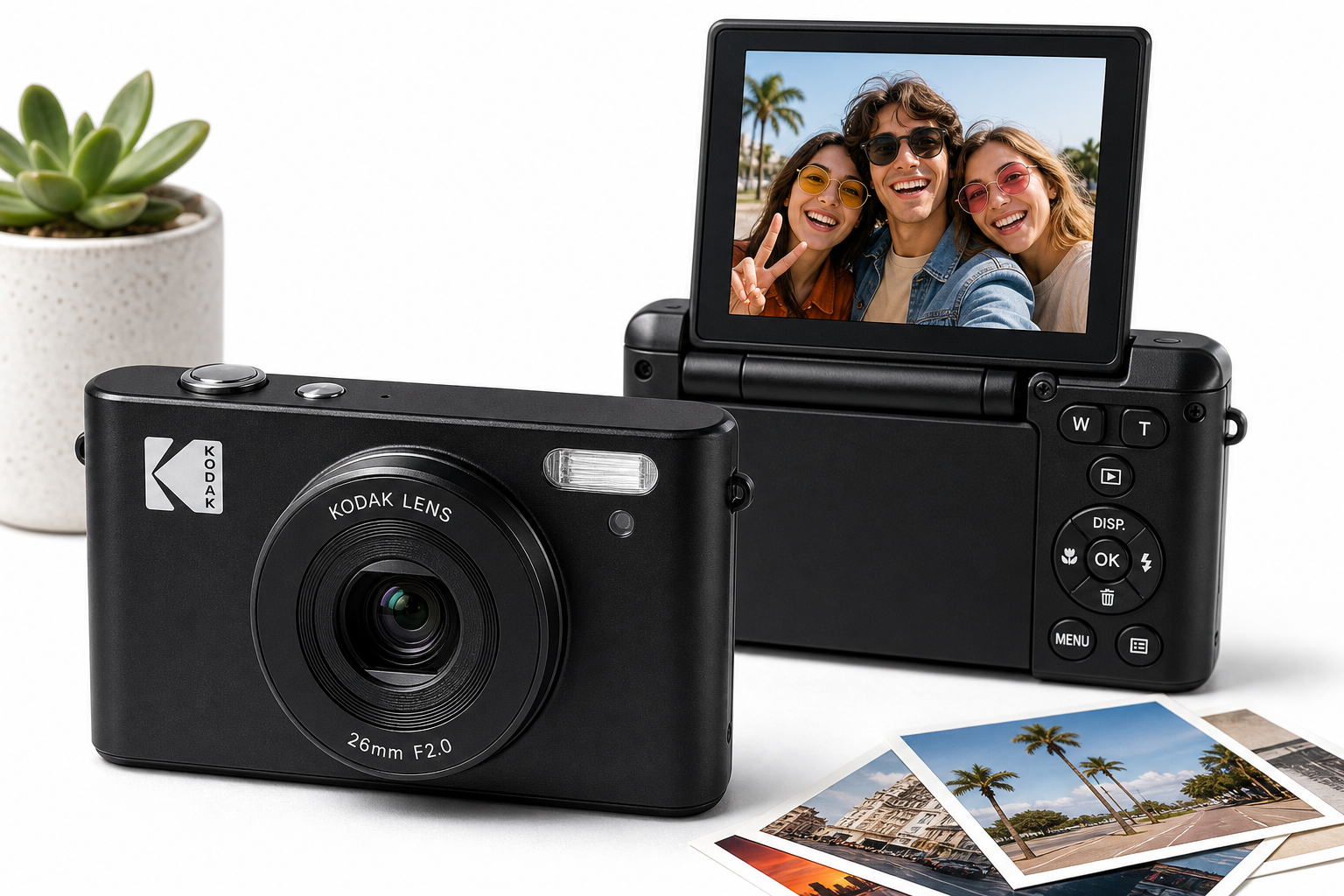
The KODAK PIXPRO C1 13MP Compact Digital Camera is a pocketable point‑and‑shoot built around a 13MP 1/3" BSI CMOS sensor, a 26mm (35mm‑equivalent) F2.0 fixed‑focus lens, a 2.8‑inch 180° flip LCD, and 1080p Full HD video recording.
It is designed primarily as a fun, easy camera for selfies, casual snapshots, and social‑media‑friendly clips rather than as a serious photography tool. The retro styling, wide fixed lens, and flip screen make it appealing for travel, parties, and everyday carry, while the lack of optical zoom and modest sensor size limit overall image quality compared with many modern smartphones and more advanced compacts.
If you want a simple, throw‑in‑your‑bag digicam with a nostalgic look and straightforward controls, the PIXPRO C1 is a compelling option. If you care deeply about image quality flexibility or low‑light performance, you will likely outgrow it quickly.
Detailed Analysis
Design and Build
The KODAK PIXPRO C1 embraces a retro‑inspired compact body with a minimalist front plate, centered lens, built‑in flash, and a flip‑up rear screen. It is:
- Very compact and lightweight, making it easy to slip into a pocket or small purse.
- Available in multiple colors, with the black version offering a classic point‑and‑shoot aesthetic.
- Built from plastic, which keeps the weight down but feels more toy‑like than premium.
There is no built‑in lens cover; the lens is exposed even when the camera is powered off. This keeps the design simple but makes a separate case or pouch highly recommended to prevent scratches.
Lens and Optics
The standout hardware feature is the 26mm, F2.0 fixed‑focus lens:
- 26mm equivalent field of view: A moderately wide angle, ideal for group shots, street scenes, and travel snapshots.
- Bright F2.0 aperture: Helps gather more light indoors or at dusk compared with the tiny, darker lenses found in many budget devices.
- Fixed focus, no optical zoom: You cannot zoom optically; framing is done by moving closer or farther away. Fine for casual snapshots, but limiting if you are used to zooming in on distant subjects.
Focusing is handled via TTL autofocus on a lens that is already designed to keep a broad range of distances reasonably sharp, especially from around arm’s length to infinity. Close‑up and macro distances are supported, but background separation (blur) is limited due to the small sensor, despite the F2.0 number.
Sensor and Image Quality
Under the hood, the PIXPRO C1 uses a 13MP 1/3" BSI CMOS sensor. This is small by dedicated‑camera standards, similar in area to sensors used in budget smartphones.
In practice, this translates to:
- Good daylight performance for social media: crisp enough for sharing, with decent color and contrast when light is plentiful.
- Limited dynamic range: Bright highlights can clip and shadows lose detail quickly in harsh lighting.
- Noticeable noise in low light: As ISO rises, fine detail softens and grain becomes evident, especially if you look closely or crop.
Images are recorded as JPEGs, with resolutions up to 13MP (4160×3120) in 4:3, and 10MP (4160×2340) in 16:9. That’s ample resolution for online use and small prints.
Video Capabilities
The camera records 1080p Full HD video at up to 30 fps, with an option for 720p. For a compact in this class, that’s respectable and suitable for:
- Casual vlogs and travel diaries
- Clips for Instagram, TikTok, or YouTube Shorts
- Behind‑the‑scenes or family moments where convenience matters more than cinematic quality
Video quality is broadly similar to stills: solid in good light, but softer and noisier in dim environments. The fixed wide lens is excellent for hand‑held selfie videos, especially with the flip screen tilted up.
Screen and Controls
The 2.8‑inch 180° flip LCD is central to the C1’s appeal:
- Flips up so you can see yourself while shooting selfies or vlogs.
- Large enough for framing and quick playback, though resolution and brightness are modest.
The control layout is straightforward:
- A top shutter button and power control
- Directional pad and a few dedicated buttons on the back for menu navigation, playback, and mode selection
There is no touchscreen, but the menu system is relatively simple, with basic modes such as Auto, Program, Night Landscape, Landscape, Backlight Portrait, Beach, Children, and Movie.
Battery and Connectivity
The PIXPRO C1 uses a built‑in rechargeable Li‑ion battery, charged via a USB connection. This offers a few benefits:
- No need to buy or carry disposable AA batteries
- Easy top‑up from power banks
On the other hand, the battery is not user‑swappable, so for long days of shooting you will need to manage charge more carefully.
For storage, it accepts microSD/microSDHC cards (check capacity compatibility in the manual before buying a card). Files are saved as JPEG for stills and MOV (H.264) for video.
Connectivity features like Wi‑Fi or Bluetooth are not the focus here; you’ll typically move files via a card reader or cable.
User Experience
Everyday Shooting
Using the C1 is largely a point‑and‑shoot experience:
- Power on the camera.
- Compose with the rear screen.
- Half‑press and then fully press the shutter (if half‑press focusing is enabled in your configuration).
- Review shots quickly and adjust as needed.
The fixed lens simplifies choices—there’s no zoom to manage—so it’s especially approachable for beginners or anyone who just wants a no‑fuss camera.
Selfies and Vlogging
The C1 is clearly tuned for selfies and front‑facing recording:
- The wide 26mm field of view fits your face and surrounding context into the frame at arm’s length.
- The flip‑up screen lets you monitor framing and expression in real time.
- The bright F2.0 lens helps keep shutter speeds usable in indoor lighting.
For quick, casual content destined for social platforms, this workflow is convenient and enjoyable.
Handling Limitations
A few aspects of the user experience may frustrate more demanding photographers:
- No optical zoom: You can’t punch in on distant subjects without resorting to digital zoom, which reduces image quality.
- Small sensor: Detail and noise performance trail many mid‑range smartphones.
- Lens always exposed: You have to be careful about how you store the camera to avoid scratches.
For users who treat the C1 as a fun, pocketable digicam rather than a main camera, these trade‑offs are often acceptable.
Pros
- Compact and lightweight design that’s genuinely pocket‑friendly.
- Retro styling with a clean, minimalist look that complements the current digicam trend.
- 26mm F2.0 fixed‑focus lens well suited to group shots, everyday scenes, and arm’s‑length selfies.
- 2.8‑inch 180° flip LCD, ideal for self‑portraits and vlogging.
- 1080p Full HD video for casual content creation.
- Built‑in rechargeable Li‑ion battery, no dependence on AA cells.
- Simple, beginner‑friendly menus and shooting modes.
- JPEG files that are easy to share and edit lightly on phones or computers.
Cons
- No optical zoom, only digital zoom, which degrades image quality when used.
- Small 1/3" sensor limits dynamic range and low‑light performance compared with larger‑sensor cameras.
- Lens is always exposed when powered off; no integrated cover increases risk of scratches.
- Build feels more toy‑like than premium; not ideal for users seeking a robust, long‑term system camera.
- Limited manual control and feature set compared with enthusiast compacts.
- No advanced connectivity options such as Wi‑Fi or Bluetooth for instant wireless transfers.
Value Assessment
The KODAK PIXPRO C1 13MP Compact Digital Camera targets a specific niche: users who want an inexpensive, dedicated digicam with a flip screen and a vintage aesthetic for casual shooting, social events, and online sharing.
Key value considerations:
- You get a true optical lens with a consistent 26mm perspective and bright F2.0 aperture, which can look more "camera‑like" than many budget phone images in good light.
- Ease of use and portability make it a strong option as a fun everyday carry camera.
- The trade‑off is image‑quality headroom and flexibility. Modern phones with computational photography can outperform it in low light, HDR scenes, and zoomed shots.
If your priority is creative enjoyment, nostalgia, and simplicity, the C1 offers solid value in its niche. If you want maximum image quality or versatility per dollar, alternatives with zoom lenses or larger sensors—or even sticking with a capable smartphone—may be more compelling.
When comparing, focus less on specs and more on how you plan to use it: if a small, stylish camera that encourages you to shoot more is what you need, the PIXPRO C1 can justify its spot in your bag.
Final Thoughts
The KODAK PIXPRO C1 13MP Compact Digital Camera, 26mm Fixed Lens, Black is best understood as a modern digicam with a vintage soul: tiny, stylish, and tuned for laid‑back photography rather than technical perfection.
It excels as:
- A selfie and vlogging companion with its 26mm wide lens and 180° flip screen.
- A fun party and travel camera for people who prefer a real camera over their phone for certain moments.
- An accessible option for beginners or younger users exploring photography.
It is less suitable if you:
- Need strong low‑light performance.
- Require optical zoom or interchangeable lenses.
- Want a primary camera for serious work or large, detailed prints.
For the right user—someone chasing the nostalgic digital camera look and a simple, always‑with‑you shooter—the KODAK PIXPRO C1 delivers a distinctive, enjoyable experience in a compact, stylish package.