
Sony ZV-E10 II vs Canon EOS R50 – Full Creator Camera Comparison Review
This paper presents a comprehensive comparative review of the Sony ZV-E10 II and Canon EOS R50, two mainstream APS-C mirrorless cameras tailored for content creators, vloggers, and amateur videographers. Covering core imaging performance, video capabilities, autofocus system, audio recording, battery life, ergonomics and lens ecosystem, the review systematically analyzes their strengths and application scenarios. The Sony ZV-E10 II excels with superior 4K 60p video recording, professional three-capsule directional microphone, flexible S-Log color profiles and an extensive third-party lens lineup, delivering powerful and versatile video performance for creative shooting. In contrast, the Canon EOS R50 features intuitive operation, outstanding out-of-camera JPEG color rendition, reliable heat dissipation for long-duration shooting, and user-friendly imaging tuning, making it ideal for beginner creators and daily vlogging. This comparison provides clear, practical selection guidance for users to choose the optimal camera based on their shooting habits, creative demands and budget constraints.
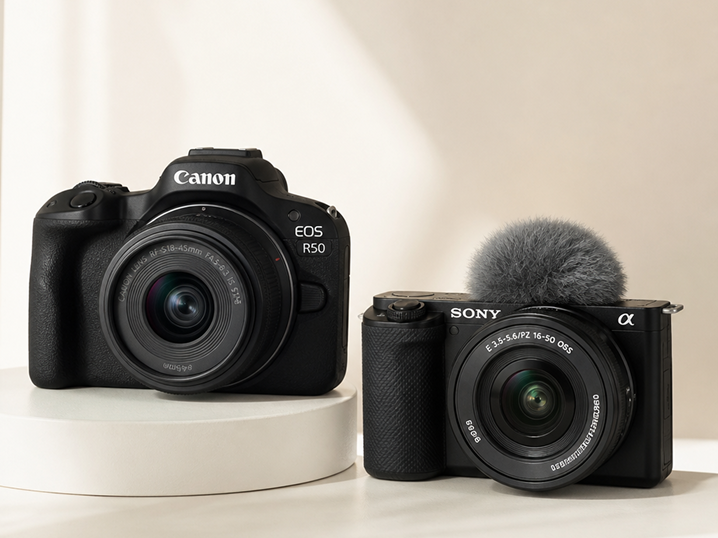
The Sony ZV-E10 II APS-C Mirrorless Creator Camera and the Canon EOS R50 Mirrorless Camera (18-45mm & 55-210mm Double Lens Bundle) are two of the most popular entry-level mirrorless cameras for content creators, vloggers, and beginner photographers on Amazon. Both deliver lightweight, interchangeable-lens performance with modern video and autofocus features, but they target slightly different user needs and creative workflows. This head-to-head comparison breaks down their core strengths, weaknesses, and ideal use cases to help you decide which system fits your shooting style.
1. Design, Portability & Usability
The Sony ZV-E10 II is purpose-built for creators, with a streamlined body optimized for handheld vlogging and daily content shooting. It features a fully articulating flip screen tailored for self-recording, simplified creator-focused menu layouts, and a compact, lightweight build that reduces fatigue during long shooting sessions. Its button layout prioritizes quick access to video, exposure, and skin-tone settings, making it extremely intuitive for vloggers who prioritize speed and convenience.
The Canon EOS R50 offers a more traditional hybrid camera design with balanced handling for both photography and video. It includes a built-in electronic viewfinder (EVF) and pop-up flash, features missing on the Sony ZV-E10 II, which greatly enhance outdoor shooting in bright sunlight and low-light still photography. Canon’s menu system is widely regarded as more beginner-friendly and intuitive for new users, with straightforward navigation that requires less learning curve. The dual-lens bundle further expands its versatility right out of the box, covering wide-angle daily shooting and telephoto zoom range for portraits and distant subjects.
2. Autofocus & Subject Tracking Performance
The Sony ZV-E10 II dominates for video autofocus performance. It boasts upgraded real-time eye autofocus for humans and animals, ultra-smooth subject tracking, and exceptional responsiveness during walking, moving, or dynamic vlogging scenarios. Its focus transition is seamless and jitter-free, which is critical for daily vlogs, talking-head videos, and lifestyle content. Sony’s optimized creator algorithms also prioritize consistent skin tone exposure, avoiding sudden brightness shifts during mobile shooting.
The Canon EOS R50 delivers reliable, precise autofocus optimized for still photography and casual video. Its dual-pixel autofocus system locks onto subjects quickly and delivers sharp, natural results for portrait shooting, family photos, and travel photography. While its video tracking is solid for static or slow-moving scenes, it is less fluid than the Sony ZV-E10 II during high-motion continuous shooting. Canon’s strength lies in its consistent focus accuracy for portrait work, with excellent face and eye detection for human subjects.
3. Image & Video Quality
For video creation, the Sony ZV-E10 II is the stronger performer. It supports high-quality 4K video recording with improved color grading flexibility, better dynamic range in high-contrast lighting, and reduced rolling shutter effect compared to many entry-level mirrorless models. It handles indoor lighting, mixed ambient light, and backlit vlogging scenarios more stably, preserving details in both bright highlights and dark shadows. The camera’s built-in creator color profiles deliver neutral, editable footage perfect for post-production tuning.
The Canon EOS R50 excels at out-of-camera JPEG image quality, especially for human portraits. Canon’s signature skin tone rendering produces warm, natural, and flattering skin colors with minimal editing required, a huge advantage for casual photographers and social media posting. Its dual-lens bundle provides versatile focal lengths: the 18-45mm wide-angle lens suits landscape, daily life, and indoor shooting, while the 55-210mm telephoto lens captures compressed portrait shots, distant scenery, and close-up details. For video, it delivers crisp, clean footage suitable for casual vlogging and short social clips, though it lacks the advanced dynamic range of the Sony model.
4. Lens Ecosystem & Expandability
The Sony ZV-E10 II uses the mature Sony E-mount lens system, which has an extensive library of affordable native and third-party lenses. Creators can easily upgrade to prime lenses for bokeh portraits, wide-angle lenses for cinematic vlogs, or macro lenses for close-up content, offering long-term upgrade potential for growing creators.
The Canon EOS R50 uses Canon’s RF mount, a modern, future-proof lens system. The included double-lens bundle provides immediate all-range shooting capability for new users with no extra investment needed. While third-party RF lens options are more limited than Sony E-mount alternatives, Canon’s native RF lenses deliver outstanding optical quality and compact sizing, ideal for users who want a complete, ready-to-shoot system out of the box.
5. Ideal Users & Final Verdict
Choose the Sony ZV-E10 II if: You are a dedicated vlogger, short-form content creator, or video-focused user. You prioritize smooth autofocus, stable video performance, flexible post-production color grading, and a creator-centric body design. It is the better long-term choice for users who plan to upgrade lenses and focus primarily on video content production.
Choose the Canon EOS R50 Double Lens Bundle if: You are a beginner or hybrid user who values both photography and casual video. You prefer flattering out-of-camera portrait colors, easy operation, built-in shooting aids like EVF and flash, and a complete dual-lens setup that covers nearly all daily shooting scenarios. It is perfect for family photography, travel content, and social media casual posting.
Both cameras rank among the best entry-level APS-C mirrorless options for new creators. The final decision comes down to your core focus: video-first content creation favors the Sony ZV-E10 II, while all-around photography and casual hybrid shooting makes the Canon EOS R50 dual-lens bundle the more practical pick.